The Traffic Accident Reconstruction Origin -Approach Angles Solution-

|
The Traffic Accident Reconstruction Origin -Approach Angles Solution-
|
|
RE: The Case of "Too Fast"
or the Law Suit of Smith v. Jones
The following is an engineering report concerning the accident which is the subject of the
above captioned matter.
ASSIGNMENT
You asked that I analyze the evidence, reconstruct the accident and determine the
causation of the accident based on the physical evidence.
COMPONENTS OF THE ACCIDENT
Date of the accident: February 27, 1997 at 1700 hours
Location of the accident: Army Road at Shopping Center Road
Vehicles involved in the accident:
Vehicle number 1:
Driver: Mr. Jones
Vehicle: Brown 1986 Dodge Lancer four door hatchback
Action Taken: Southbound on Army Road approaching a signalized intersection where Jones stated that he had a green signal. Jones stated that he applied brakes prior to colliding with Vehicle 2. Jones also stated that he swerved prior to the collision, but the physical evidence does not support that as being a fact.
Vehicle number 2:
Driver: Mr. Smith
Vehicle: 1993 BMW 325i four door sedan
Action Taken: Northbound on Army Road, was turning left into Shopping Center Road when Vehicle 1 collided into him. Smith stated that he had a ball green signal.
The basis for my analysis is as follows:
WEATHER CONDITIONS
The weather was clear and the pavement was dry.
DESCRIPTION OF THE ROAD AND ITS TRAFFIC CONTROL
Army Road is a six lane divided street with three lanes of through traffic plus a protected
left turn bay for both the northbound and southbound traffic and a concrete center median
assumed to be five feet wide. All lanes are assumed to be 12 feet wide. Army Road is a major
arterial street with a speed limit of 45 miles per hour.
Shopping Center Road is a three lane street with two exit lanes and one entrance lane.
The intersection is controlled by a traffic signal including a five section head for the
northbound left turn lane.
Note: The narrative description of the accident states that Shopping Center Road is
a four lane divided street with a center median. This engineer has relied on the accuracy
of the drawing concerning the geometrics of this street. However, the differences in the
geometrics do not influence the conclusions.
DAMAGE TO THE VEHICLES
Damage Assessment to vehicle 1, Jones' Dodge: The right half of the front is crushed
toward the rear and a little to the right. This engineer concludes from the damage assessment
of the Dodge that the BMW was not moving fast at the time of the collision or else the
displacement of the damaged area of the Dodge would be more substantial to the right. The
right front wheel of the Dodge was jammed as a result of the frontal collision. The major
deformation of the front is at the right front corner with the contact area across the front being
about two feet wide. The twin headlight assembly on the right side is demolished and dangling
by the electrical wires.
Damage Assessment of vehicle 2, Smith's BMW: The rear of the right rear door panel
and the leading edge of the right rear quarter panel are crushed inward in front of and above
the right rear wheel well. Once again, since the damaged area on the BMW is not a prolongated
deformation from front to rear along the BMW's right side indicates to this engineer that the
BMW was not moving fast as it moved from the Dodge's left to right at impact.
PHYSICAL EVIDENCE ON THE ROAD
The Dodge left 62.5 feet of right side skid marks and 47.5 feet of left side skid marks prior
to impact. After impact, the vehicle left 14.5 feet of skid marks from the right and left side tires,
plus a final nine feet of skid marks on the right side only.
There was no evidence of pre-impact braking on the part of the BMW.
FACTUAL MATERIALS REVIEWED
TARO's description of the accident and photographs.
SPECIAL TECHNICAL MATERIALS REVIEWED
Manufacturer's specifications of vehicle measurements and curb weights for the 1986
Dodge Lancer four door hatchback, and for the 1993 BMW 325 I four door sedan, taken from
Expert Autostats, with this engineer allowing an additional 300 pounds for the weight of the
occupant, fluids and any cargo.
Note: The Dodge has front disc brakes and rear drum brakes.
CALCULATIONS AND OPINIONS
Based upon my education, training and experience as a civil engineer specializing in
traffic accident reconstruction and evaluation of highway design and maintenance, I have
formulated the following opinions:
NOTE: This author did not use any computer software programs to aid with the
calculations. The long-hand computations are attached as enclosures 2 through 6.
A. THE OBJECTIVES OF THIS ANALYSIS: There are several points
of interest to be determined and analyzed:
1. How fast was the Dodge traveling prior to braking, referred to herein as the "initial
speed of the Dodge"?
2. How fast was the Dodge traveling at its impact with the BMW, referred to herein
as the "pre-impact speed of the Dodge"?
3. How fast was the BMW traveling at its collision with the Dodge, referred to herein as the
"pre-impact speed of the BMW"?
Note: since the BMW did not brake prior to the collision, the initial speed of
the BMW is also its pre-impact speed.
4. Where was the Dodge when the BMW first started to negotiate the turn?
5. Where was the BMW when the Dodge entered the intersection?
6. Could the driver of the Dodge have reasonably been able to have seen the BMW
turning into his path and have taken evasive action?
7. What evasive actions could have been taken by the driver of the Dodge?
8. Could the driver of the BMW have reasonably been able to have seen the Dodge
and have taken evasive action?
9. What evasive actions could have been taken by the driver of the BMW?
10. If the analysis shows that the Dodge was speeding, would there have been an
accident if the Dodge had been going the speed limit, or less?
PHILOSOPHICAL NOTE BY THIS ENGINEER ABOUT CALCULATIONS OF
SPEEDS: Notice in this report that this engineer usually refers to
the results of
the calculations as being "about". The reason is that so many of the assumptions
and measurements used in calculations of accidents are not exact. For example,
the beginning of skid marks is often difficult to determine. Also, the drag factor
between a tire and the road surfacing can vary from vehicle to vehicle and from
one location to another along a roadway. If the lowest values from all variables,
assumptions and measurements are used in the calculations and if the highest
values are used, there will be a range of results. Unless a more exact calculation
is needed to determine the liability issues, this engineer does not deem it
reasonable for the reconstructionist to try to imply by his calculations that these are
exact figures. Furthermore, conclusions derived from the calculations frequently
do not require exactness. For example, if the issue is merely to determine if a
vehicle was speeding, what difference does it make that a vehicle was traveling at
48 miles per hour or at 52 miles per hour in a 45 mile per hour speed zone? The
vehicle was speeding in either case. However, this is not to say that there are
situations when exactness is required. Similarly, unless other considerations
dictate it, speeds should not be referred to in tenths or hundredths of miles per
hour. For all of the math intellectuals out there, this discussion is referred to as
significant numbers, but some of us forget about it from time to time.
B. THE ANALYSIS:
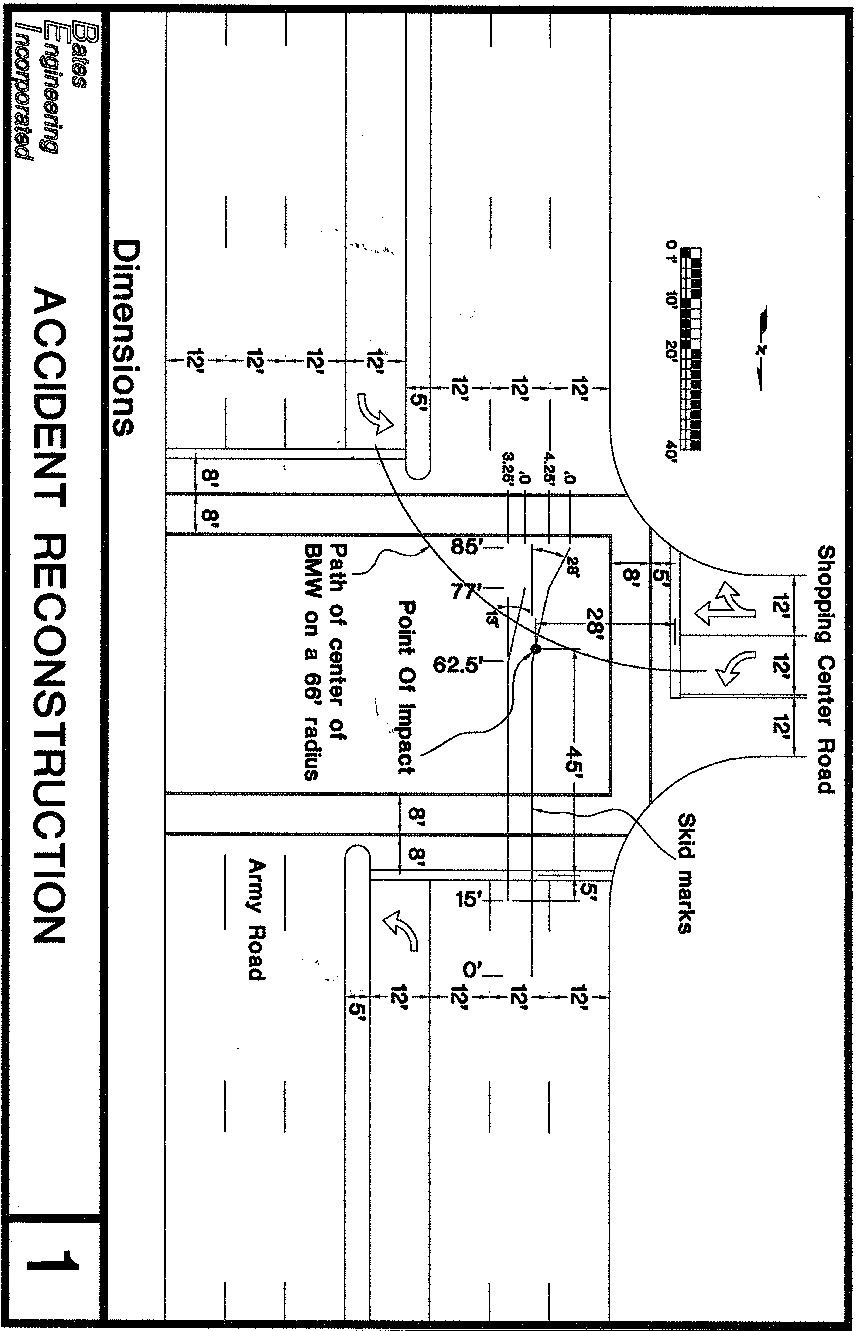
1. The first task for this reconstructionist is almost always to prepare a scaled drawing of
all known features of the scene of the accident and all facts which can be determined
readily. Preparation of this drawing (enclosure 1) enabled this analyst to
measure, among
other things, that the Dodge had traveled 42.5 feet beyond the stop line (entered the
intersection) prior to it making contact with the BMW.
2. A further analysis of the drawing can be made about the BMW's path. The driver of the
BMW was evidently cutting the corner; that is, the projection of the BMW's path from the
left turn lane to a path beyond the point of impact (POI) indicates that the BMW would
have entered Shopping Center Road on the wrong side of the street. This fact suggests
to this engineer that the BMW might have initially been on a path which would have taken
it to the correct side of the street, but, at the last moment prior to the collision, the driver
saw the oncoming Dodge and, perhaps, sped up and shortened his radius in order to get
on across the intersection and attempt to avoid a collision. This analyst would have liked
to have had the opportunity to interview Mr. Jones concerning this hypothesis. In the
absence of that interview, the path of the BMW has been depicted as a smooth arc.
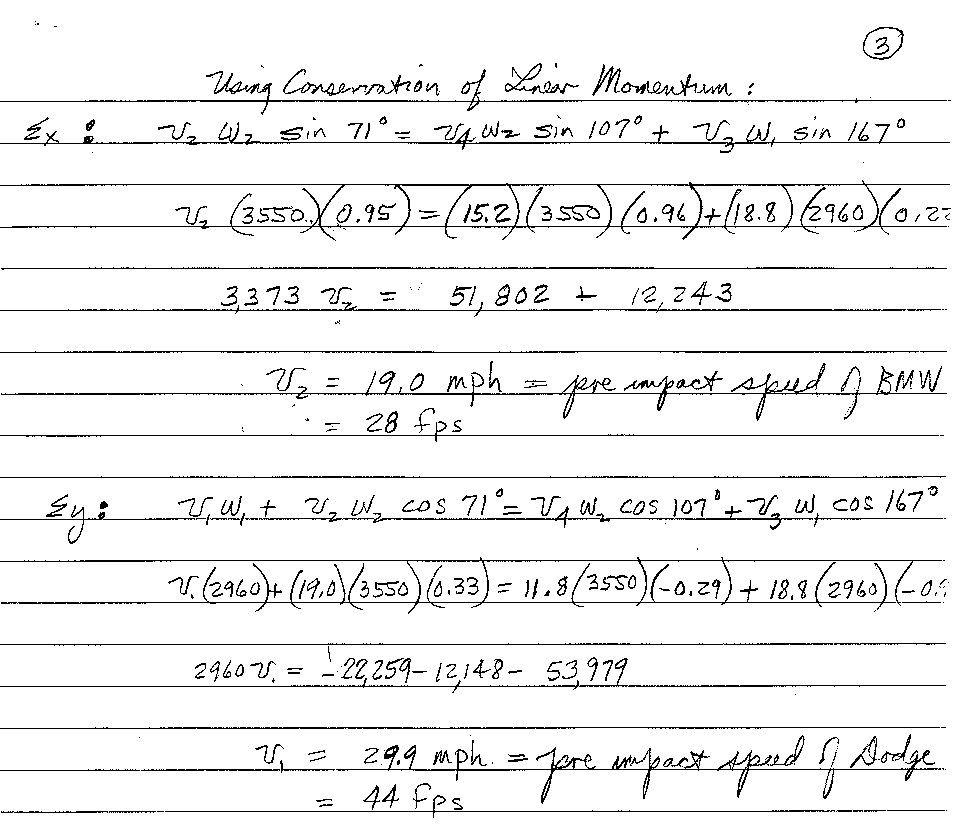
3. There is a mathematical relationship of Newton's Laws of Motion called the conservation
of linear momentum. This principal states:
The total momentum of all vehicles prior to a collision is equal to the total
momentum of those vehicles after the collision. There will normally be a transfer
of momentum from one vehicle to the other but the total is a constant and is
conserved.
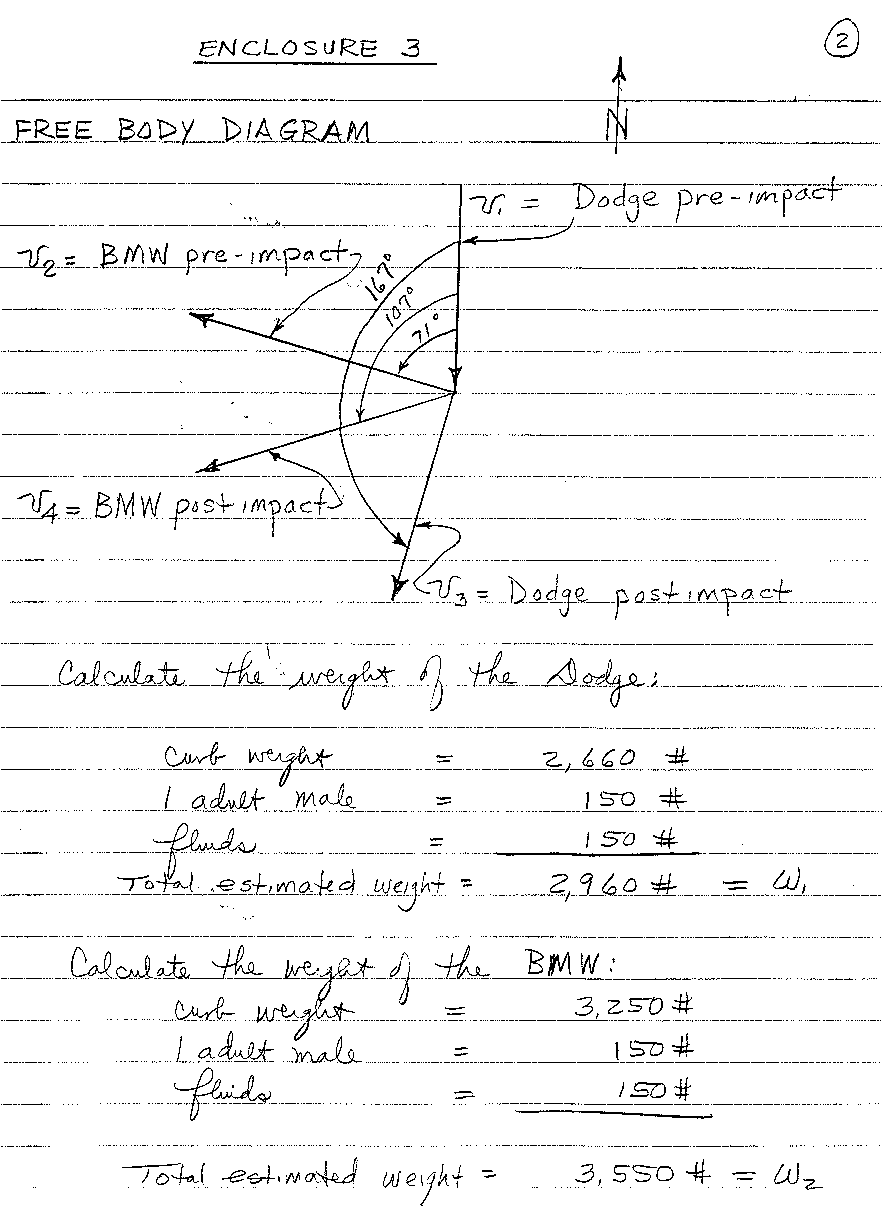
This relationship of the Conservation of Linear Momentum will enable this analyst to
determine the pre-impact speed of the BMW and the pre-impact speed of the Dodge. In
order to perform this mathematical operation, the post impact speeds and departure
angles of the two vehicles must first be calculated.
4. The mass center of gravity of the BMW rotated about 145 degrees from the POI to its
point of rest (POR) and its mass center of gravity (located approximately in the middle
of the back of the front seat) traveled about 11 feet.
Note: The accuracy of these calculations is dependent on all linear and angular
measurements being made with respect to the mass center of gravity.
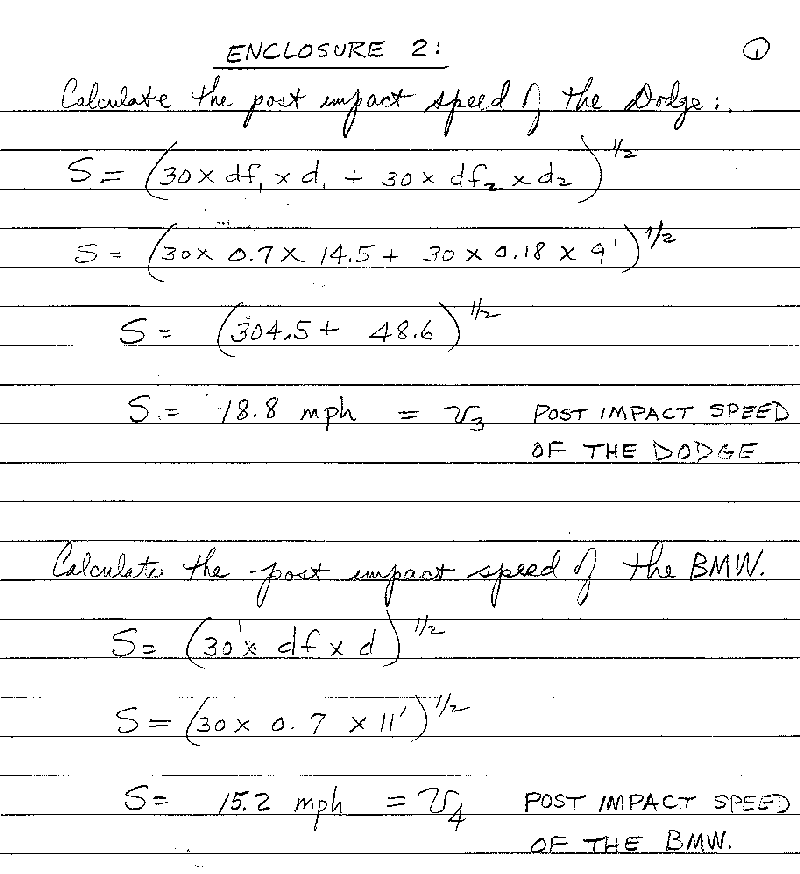
5. During that post impact maneuver, the wheels of the BMW were probably not locked up,
but functioned as if they were locked up, because the tires were generally moving at right
angles to the direction they were pointed. Therefore, applying an assumed drag factor
for the pavement of 0.7 produces a post impact speed for the BMW of about 15 mph
(enclosure 2). Plotting the BMW on the scaled drawing at the POI and at its POR allows
this analyst to scale the departure angle of the BMW to have been about 107 degrees
from north.
6. Similarly, the Dodge had two post impact skid distances of note. The first distance of 14.5
feet (77 feet minus 62.5 feet) has a departure angle of about 13 degrees from north; that
is, the arc tangent of 3.25 feet of offset divided by 14.5 feet is 13 degrees. During this first
distance, it appears that the four tires of the Dodge were locked up and, therefore, the
drag factor 0.7 is assumed. However, at the end of the 14.5 feet, the driver of the Dodge
apparently released the brakes. Perhaps his foot was jarred off the pedal as a result of
the impact.
NOTE: The narrative states that the driver of the Dodge tried to move his
vehicle off the road after the accident but was unable to do so. This analyst has
assumed that the last 9 feet of movement was not made when the driver was
trying to move the car. However, if the energy dissipated in that 9 feet was
disregarded, the conclusions about the causation of the accident would not be
affected.
7. The second post impact distance of note for the Dodge is the final distance to the its
POR. This distance is calculated to be 9.0 feet and is arrived at from being the square
root of the sum of 4.25 squared and 8.00 squared (85' minus 77') (enclosure 2). The
angle of this distance is irrelevant for the calculations of the Conservation of Linear
Momentum because this last deflection was not associated with the departure angle at
the collision. It is the departure angle that must be used in the calculations. However, the
amount of energy dissipated along this final distance is still relevant and should be
considered. During this final distance, the Dodge was not braking but was slowing only
as a result of the right front wheel being jammed. Therefore, since only one wheel was
applying resistence to movement, the effective drag factor is assumed to be 0.7 divided
by 4, or 0.18. Using the combined formula, the post impact speed of the Dodge is
calculated to have been about 18.8 mph (enclosure 2).
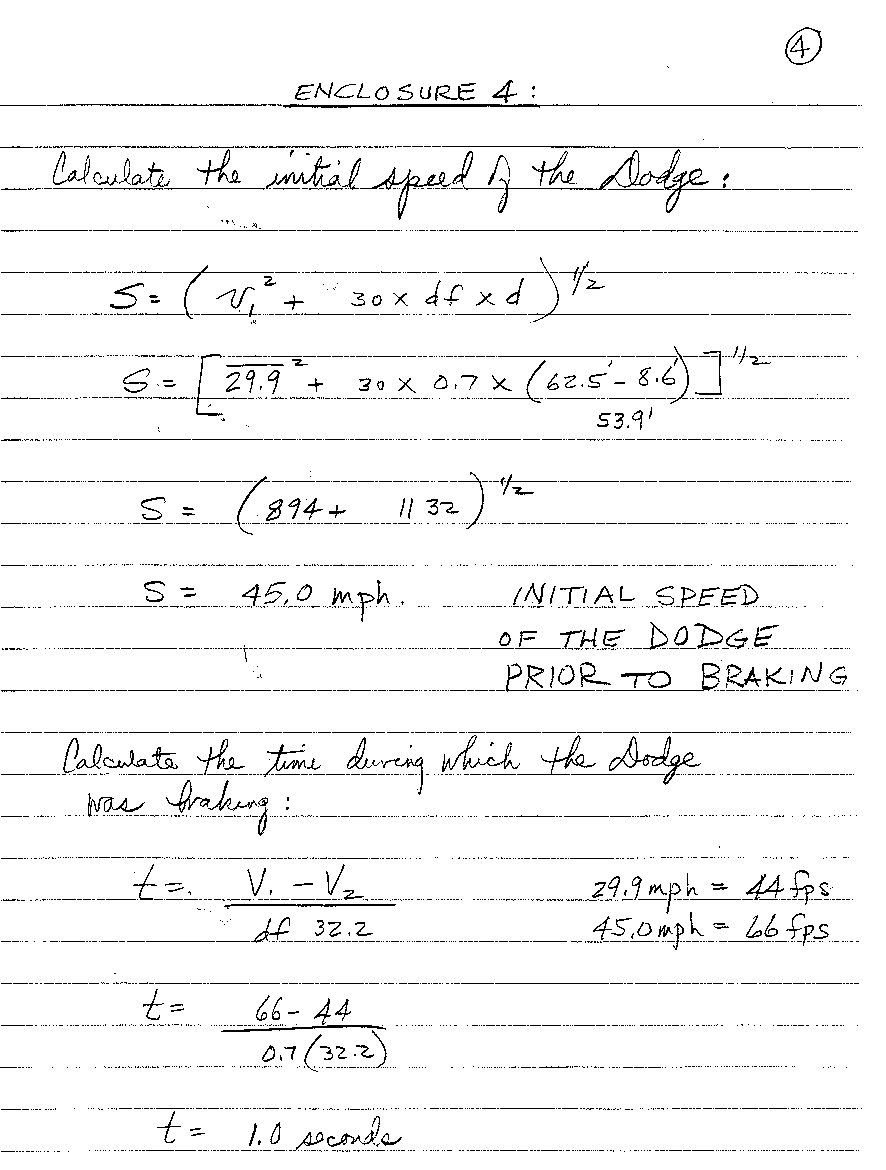
8. Using the procedure of the Conservation of Linear Momentum, the pre-impact speed of the BMW can be calculated (enclosure 3 enclosure 3b) to be about 19 miles per hour and the pre-impact speed of the Dodge to be about 30 miles per hour. However, the Dodge skidded for 62.5 feet prior to contact with the BMW. Therefore, using the combined speed formula (enclosure 4), the initial speed of the Dodge is calculated to have been about 45 mph.
It should be noted that the driver of the Dodge stated that he was traveling at about the
speed limit of 45 mph. This computation shows that his statement is consistent with the
physical evidence. The calculations further reveal that the Dodge traveled 1.0 seconds
prior to contact with the BMW while skidding.
9. From the drawing, this reconstructionist can perform a simple calculation to make a fast
check about the accuracy of the calculation of the speed of Smith's BMW at the POI. That
calculation is called the critical speed. The critical speed is the maximum speed which
a car can go around a turn without losing control and going into a yaw or a broadside
skid. A car can negotiate a curve with a 66 foot radius when traveling up to 26 miles per
hour on dry pavement (enclosure 5), which is less than the calculated
pre-impact speed of the BMW of 19 mph. Therefore, since there is no evidence that the BMW
was out of control in negotiating the turn, we can conclude from this calculation that the BMW
was going at or less than 26 miles per hour at the POI and, therefore, much less than the
speed limit of 45 miles per hour. The calculation of the critical speed of the BMW shows
that the calculation of the pre-impact speed of the BMW of 19 mph is not out of line.
10. Based on the drawing, the path of the BMW can be traced from the location where the
car left the confines of the left turn lane to its position at the POI. This path indicates that
Smith traveled along a path of about a 66 foot radius while making his left turn and
traveled for a distance of about 58 feet from the time he crossed the stop line in the left
turn lane (entered the intersection) to the POI.
11. The time that it took the BMW to travel from the stop line of the left turn lane to the POI
is calculated to have been 2.1 seconds (enclosure 5), or 58 feet divided by
28 feet per second (19.0 mph). This means that the BMW was 31 feet into its turn when the
Dodge first locked up its brakes ( as depicted in enclosure 7).
12. The BMW proceeded into the intersection on a ball green signal to make a left turn. The
law in most states requires that, unless a vehicle has an exclusive left turn arrow signal,
the driver of a vehicle turning left must "yield to all vehicles within the intersection and
within an imminent hazard distance of the intersection". The facts in this case are that
BMW executed its turn from the northbound left turn lane into the Shopping Center
without stopping (and probably without slowing) because he had a green light and said
that he thought there were no vehicles within an imminent hazard distance of him. This
engineer has interpreted "imminent hazard distance" in this manner.
Determine the time which it takes a turning vehicle (in this case, the BMW) to clear
the opposing lanes of traffic at the rate of speed that the vehicle is crossing the
intersection. Add to that calculation the fact that there should be a two second
separation between vehicles. That time multiplied by the speed limit, expressed in
feet per second, gives the distance in advance of the intersection that the turning
vehicle must yield to oncoming traffic.
13. If the BMW had not been involved in an accident, it would have traveled about 73 feet
from the moment it crossed the stop line in the left turn lane to the time it cleared the
opposing lanes of traffic. At 19 miles per hour, that would have taken 2.6 seconds
(enclosure 6). The clearance time required is then the 2.6 seconds of travel
time plus the two seconds of separation between vehicles, or 4.6 seconds. Therefore, the driver of
the BMW was required to have yielded to all traffic within about 304 feet of the stop line at
the north approach of the intersection. (45 mph expressed in feet per second times 4.6
seconds) Since the Dodge was about 246 feet from the stop line of the intersection when
the BMW crossed its stop line (that is, entered the intersection), the BMW should have
yielded to the Dodge (as depicted in enclosure 8).
14. Although the accident occurred near sunset, it occurred while the drivers of both vehicles
were looking to the north or south to see the other vehicle, so neither of the drivers was
blinded by the setting sun. The position of the sun is, therefore, irrelevant to the
causation of this accident.
15. The fact that Jones had a suspended driver's license at the time of the accident is
irrelevant to the causation of the accident unless it can be shown that he had
incompetent driving skills.
C. SUMMARY OF FINDINGS AND CONCLUSIONS:
1. How fast was the Dodge traveling prior to braking, referred to herein as the "initial speed
of the Dodge"? about 45 mph which is the posted speed limit.
2. How fast was the Dodge traveling at its impact with the BMW, referred to herein as the
"pre-impact speed of the Dodge"? about 30 mph.
3. How fast was the BMW traveling at its collision with the Dodge, referred to herein as the
"pre-impact speed of the BMW"? about 19 mph.
4. Where was the Dodge when the BMW first started to negotiate the turn (enter the
intersection)? about 250 feet north of the intersection.
5. Where was the BMW when the Dodge entered the intersection? 31 feet into the turn;
that is, the front of the BMW was beginning to cross into the lane that the Dodge was in.
6. Could the driver of the Dodge have reasonably been able to have seen the BMW turning
into his path and have taken evasive action? No. The BMW traveled for 2.6 seconds into
the intersection prior to the collision. The Dodge braked for 1.0 seconds prior to the
collision. This means that the driver of the Dodge had a maximum perception-reaction
time of 1.6 seconds (2.6 seconds minus 1.0 seconds). It is not reasonable to expect that
the driver of the Dodge could detect the BMW's encroachment into the Dodge's path
much, if any, faster than he did.
7. What evasive actions could have been taken by the driver of the Dodge? The Dodge
did apply the brakes. The only other evasive actions possible were to swerve to the left by
about four feet to pass in back of the BMW's movement, and to honk to alert the other
party to take action.
a. At 45 mph, a car would travel about 52 feet along the roadway in order to swerve
three feet if the driver jerked hard on the steering wheel (enclosure 9).
The Dodge braked for about 54 feet (that is, 62.5 feet of skid minus the wheelbase length)
prior to impact; however, if the driver of the Dodge jerked and braked simultaneously, the car
would have gone into a yaw or broadside skid, because the Dodge does not have anti-lock brakes.
The collision would probably have occurred anyway as the two vehicles came together in a
clapping arrangement.Nonetheless, if the Dodge had veered to the left instead of braking, the
calculations show that the Dodge could have barely missed the BMW. However, the BMW was
completely on the left side of the Dodge and moving to the Dodge's right at the instant when the
veering maneuver would have had to begin. This engineer believes that it is unreasonable to
expect a driver at that instant to choose jerking the steering wheel to the left toward the BMW.
b. The driver of the Dodge could have honked to have alerted the driver of the BMW
to take action, but whether that would have been effective in such a short period of time is
doubtful.
8. Could the driver of the BMW have reasonably been able to have seen the Dodge and
have taken evasive action? Yes. The Dodge was within a reasonable distance to have
been recognized as being within "an imminent hazard distance".
9. What evasive actions could have been taken by the driver of the BMW? The driver of
the BMW should have stopped prior to entering the opposing lanes of traffic. The distance
required for the BMW to skid to a stop is only about 17 feet plus perception-reaction distance. By
the time that the BMW entered the intersection, the Dodge had been within the "imminent hazard
distance for about 0.8 seconds.
10. If the analysis shows that the Dodge was speeding, would there have been an accident
if the Dodge had been going the speed limit, or less? This question has become irrelevant
since the calculations reveal that the Dodge was not speeding.
Based on the physical evidence, it is the opinion of this reconstructionist that the driver
of the BMW was not devoting his full time and attention to his driving and, as evidenced by the
BMW cutting the corner, the driver of the BMW was probably in a hurry. The driver of the BMW
had a duty to yield to the Dodge. The driver of the Dodge had a duty to avoid an accident
regardless of what others do, and he was taking an accident avoidance procedure.
It is the opinion of this reconstructionist that this accident was avoidable.
JOHN T. BATES, P. E.
ACTAR Certificate # 80
for
Bates Engineering Inc.
BIOGRAPHICAL SKETCH OF JOHN T. BATES
Mr. John Bates, a Civil Engineer specializing in traffic accident reconstruction and evaluation of
highway design, has reconstructed over 3,000 accidents in 18 states during the past 25 years.
Mr. Bates, who offices in Oklahoma, received a Bachelor of Science in Civil Engineering degree from the University of Texas at Austin in 1956. He is a Registered Professional Engineer and has practiced engineering for over 40 years, including the design of streets, highways, bridges and traffic control devices. He is a member of numerous professional engineering societies.
Mr. Bates has received specialized training in traffic accident reconstruction, and holds a Certificate of Accreditation from the Accreditation Commission for Traffic Accident Reconstruction. He has authored numerous articles and is a frequent guest speaker on traffic accident reconstruction subjects. In addition to teaching engineering courses part time at several colleges and universities, he has given continuing legal education seminars and other seminars in several law schools.
Mr Bates can be reached at [email protected]
|
Copyright ©
|